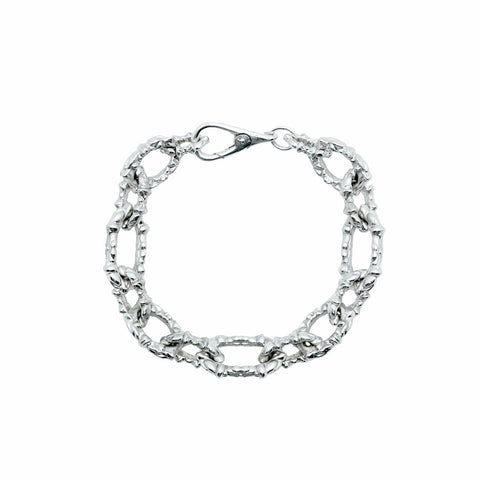
Weight is the first thing people notice about a bracelet and the last thing a product photo can show you. Two bracelets can look identical on a screen and feel nothing alike on the wrist. Here is what creates that difference.
SOLID, HOLLOW, OR PLATED
Almost every silver looking bracelet on the market is one of three things. Solid sterling silver all the way through. Hollow links formed from thin sheet with air inside. Or a base metal carrying a thin silver or rhodium layer on top.
They photograph the same. They do not wear the same. Hollow links dent and crease and cannot really be repaired. Plating wears through at the clasp and the contact points first, and once the base metal shows there is no fixing it without replating the entire piece.
The silver bracelets in this studio are solid 925 sterling silver. When one of them feels heavy, that is material, not a design trick.
WHERE EACH PIECE COMES FROM
Most of what you see here is cut, soldered, oxidized and finished in the studio, by one person, after you order it. A small number of pieces are stainless steel, and some silver pieces are produced with a partner workshop rather than on the bench here. Where that is the case it is written in the product description, so you can see it before you buy rather than after.
Saying so is the point. A shop that never mentions a partner workshop is not necessarily doing everything itself, it is just not telling you.
WHY HANDMADE CHANGES THE OBJECT
Each studio piece is finished by hand, so the surface, the patina, and the way light catches the edges vary slightly from one to the next. It also means the clasp gets chosen for daily wear rather than for a photograph, because the person building it is the person who hears about it if it fails.
Production runs between 5 and 45 days depending on the piece, most of the time around 7. Nothing ships off a shelf.
MEASURING YOUR WRIST
Wrap a strip of paper or a tape measure around your wrist, just past the bone, snug against the skin. Read it in centimeters. That is your bare wrist measurement, and it is the number to send. If your ruler is in inches, multiply by 2.54 to get centimeters.
Avoid string for this if you can. String stretches under tension and hands you a number smaller than your wrist actually is. Paper does not.
Then decide how it should sit. Add roughly one centimeter for a close fit that stays put, or two for a bracelet that moves and slides. For heavier pieces the looser option is usually the more comfortable one, because weight that cannot move ends up pressing on one spot all day.
WEIGHT AND FIT INTERACT
A light chain can sit tight without bothering you. A massive one cannot. The heavier the bracelet, the more room it wants, and getting this wrong is the most common reason a piece someone loves ends up in a drawer.
Some designs solve it outright. The INFINITUS heavy bracelet is adjustable between 18 and 20 centimeters, so you can move it after it arrives.
WHAT ARRIVES
Every order comes with the Frantic pouch, a metal box, a sleeve, a polishing cloth, care instructions and a ring sizer. The cloth matters more than it sounds, because uncoated silver darkens and a minute with the cloth resets it. Keep the ring sizer, it is the easiest way to get a size right next time.
The full range sits in heavy sterling silver bracelets. For the darker finishes start with Requiem, and if you want to understand how the patina behaves, read why this silver tarnishes.